Showing posts with label Teaching Tots At Home. Show all posts

Sunday, July 21, 2013

Teaching Your Tot to Read

A few parents have asked how my 4-year-old learned how to read (she can now read at Grade 2 level). Happily, I didn't have go through Kumon, reading schools, tutors, or any of those uber-expensive reading kits (complete with books, worksheets, and DVDs!). Here are the steps we took; given her progress, I suppose it works:

(1) Always read to your tot. From the moment she could sit up, we started with Fisher Price board books. The stories were short, educational, colorful, and easy to handle. You have to get your child interested in books so that he/she will be willing to learn how to read. Kids love to emulate, so it's better if you're a reader yourself. It doesn't have to be books; if you're not an avid reader of pocketbooks, then why not read magazines instead?

(2) Teach ABC's and abc's. Naturally, to be able to read, your child will have to know all the letters and the distinguish upper from lowercase. Start with the capital letters. There are a lot of baby books that teach letters, but I found that simple flash cards were more effective. Books and cards with too much going on (or with familiar characters such as Mickey Mouse, Sesame Street, etc.) proved to be too distracting.

(3) Teach the sounds. Once your tot can recognize the letters by heart, it's time for him/her to know the sound associated with each letter. LeapFrog Fridge Phonics helped a lot, as did the ever-dependable flash cards.

(4) Put the sounds together to form words. A magnetic drawing board or erasable board helps a lot at this stage. Start with a simple word like "CAT". Break it into the sounds "Cuh" "Ah" "Tuh". Then erase and replace the first letter with say, "M". Break it into sounds, emphasizing that the first letter now corresponds to a different sound "Mmm" to say "MAT". Repeat for BAT, PAT, SAT, and so on. Be sure to use words that your tot is already familiar with! Use a different word base everyday. For example, the next day you can use "CAKE" and replace with "TAKE" or "MAKE". Once your child has the hang of it, start changing the last letters instead of the first letters, such as ""MAN" to "MAD", "MAT", "MAP", etc.

JOYTOY'S Spelling Fun Set includes 3-piece and 4-piece puzzles that helped my toddler learn to build words (and build puzzles to boot!). 

(5) Familiarize your tot with sight words (i.e., most common words used in English language). The first learning-to-read books I noted in a previous post are a good place to start.

(6) Ready to read REAL books? Disney Reading Adventures Pre-Level 1 boxed sets contain books that are engaging, short, and easy to learn. Just the thing to boost the confidence of your early reader! Dr. Seuss books are also highly recommended, though my daughter never went through these because the cat scared her. I have a friend who says her child learned to read through the Dr. Seuss iPad app.

(7) Keep on reading. Move on to Level 1 and Level 2 Ready-to-Read books. There are dozens of titles and variations available at the bookstore, featuring many of the most popular cartoon characters of today.

I asked my daughter what was most effective in teaching her how to read. She said that apart from Mommy's lessons, the "subtitles" on her cartoons helped a lot also. Something to think about. Good luck! :-)

Monday, July 23, 2012

Learning How to Read Next Steps: Disney's Adventures in Reading

In my April 15 post, Learning How to Read First Books, I listed websites that featured simple 1-page stories that my daughter could follow. While she was happy to finally read on her own, the novelty of these simple, repetitive tales soon wore off and she started looking for real books with real stories. Unfortunately, a lot of the Level 1 learn-to-read type books were still too complicated for her and frustrated her to no end.

Disney came to our rescue with their new Reading Adventures Pre-Level 1 set. Each boxed set contains 10 illustrated books, stickers, achievement certificate, and parent letter. The stories, while simple, are engaging to the little ones due to their familiar characters and themes like friendship, feelings, seasons, etc. I bought the Mickey Mouse set to start with. My daughter read through the whole set in two days and loves the books! It also gave her the confidence to try reading other, more complicated books using similar sight words. I'm looking forward to trying the Winnie the Pooh version next.

Both boxed sets are available locally, at National Bookstore.

Sunday, April 15, 2012

Learning How to Read: First Books

So when my 3-year-old came up to me and said "Mommy, I want to learn how to read!" I eagerly started our lessons. She learned her letters and sounds already, so I figured some phonetics lessons and will be on our way to early reader books.

I could not have been more wrong. Most of the common words used in stories don't always follow the simple sound rules. "Me" is "M-ee" not "M-eh". "You" is "Y-oo" not "Y-oh-uh". And so on.

A preschool teacher brought me in the direction of "sight words" - the most frequently used words in the English language that kids should memorize. Sounded easy enough, but going through the words was boring and tedious for both me and my child. I could tell she was fast losing interest and knew I had to involve her more in the reading process.

I was also advised to find books with rhyming words. I browsed through the large selection in both National Bookstore and Power Books, but all the shelves of Pre-Level and Level 1 reader books still seemed to complicated for my daughter. The closest ones I found that were easy for her to grasp were Dora's So Many Bananas and Mickey Mouse's Are We There Yet? Where were the simple "See Jack run" and "See Jill play" books from my day?

Finally, I stumbled upon two great resources for free books for first time readers:

http://www.clarkness.com/Single%20Page%20Stories%20page%201.htm


While my daughter is disappointed that they're not real books, I finally saw progress (and by the way her eyes sparkled, she did too!) as she read through the 1-page stories all on her own. It's slow going, but so were the lowercase letters, writing, and cutting in the beginning...so I'm still confident that we'll get the reading down pat too!

Incidentally, another great find for me is Disney School Skills: Sight Words which so far, has successfully taught her to recognize the words for the days of the week and colors.

Sunday, February 5, 2012

Tot Can't Cut It?

Is your child having a hard time handling scissors? Is your child holding the scissors incorrectly, with the thumb pointing downwards? Is he or she cutting for all its worth, but still unable to make any kind of cut on the paper? Join the club! After trying out some cutting exercises with my 3-year-old daughter - who was near tears when she realized she just couldn't cut the paper on her own - I turned to Google for help. Thankfully, the ever-faithful search engine did not disappoint. Here's how my child learned to cut on her own within 1 week:

(1) Have your child hold the scissors the proper way. The thumb should go in one of the holes. The other hole should have the middle and ring fingers. The pointer or index finger should be outside, helping the middle and ring fingers push the lower part of the handle. The thumb should always be on the top side. Sometimes it helps to put a sticker on the lower part of your child's thumb as a guide - he/she would know she's holding it right side up if he/she could see the sticker.

(2) Use thin cardboard paper first. Calling card paper sold in National Bookstore or any Office Supplies store would do. Because the paper is firm, it will be easier for the child to cut through (i.e., most of the time ordinary paper would crumple easily or follow the scissors if the child does not yet have the proper grip or control). Because it's thicker than ordinary paper, it's also good for strengthening your child's grip and control of the scissors.

(3) Draw lines on the board paper for your child to follow. Start with simple straight lines, then slanted, then curved. Practice everyday, but stop when your child says he or she is tired.

After a week of practicing on at least one board paper a day, my daughter gained confidence. Her face simply lit up when she cut her first board paper! On the fifth day, I gave her the paper exercises again and this time, she finally had the proper hand grip and was able to cut through the lines without any problems.

Another good tip I found was in teaching the proper way to hold the scissors. Teach your child to grasp the blades (when closed) within their fist. Do a simple march after the cutting exercises to help them remember the proper way of holding scissors while walking.

Lastly, make sure you are using scissors appropriate for your child's size and age!

Thursday, August 18, 2011

Teaching Babies and Toddlers: Telling Time

If your tot can already recognize numbers (at least 1 to 10), now is a good time to introduce him/her to the concept of time. Start with the simple hours - 1 o'clock, 2 o'clock, etc. Don't worry about minutes yet. The important thing is that they can differentiate between the short and long hand and know that they base the hour on the short hand.

Give them a toy clock to practice telling time. It can be as simple as a cardboard clock with movable hands. My favorite find is Joytoy's version, which is readily available at toy stores and National Bookstore. One side of the inexpensive cardboard clock has movable hands while the other side features a clock with no hands - instead, your tot can draw the hands using a dry-erase marker. You can start teaching your child via the movable hands and use the flip side when he/she is a little bit older.

Once your child has a basic idea of how to tell time, you can reinforce the concept by referring to the real clock for times of the day that are important to him/her. For example, just before his/her favorite show comes on, you can say "Look, what time is it? The clock says it's 7 o'clock! That means it's time for Mickey Mouse!". You can also refer to the specific hour of the day that he/she will take a nap, sleep, take a bath, eat, etc. Pretty soon your tot will realize the importance of looking towards the clock in order to tell the time.

Thursday, June 30, 2011

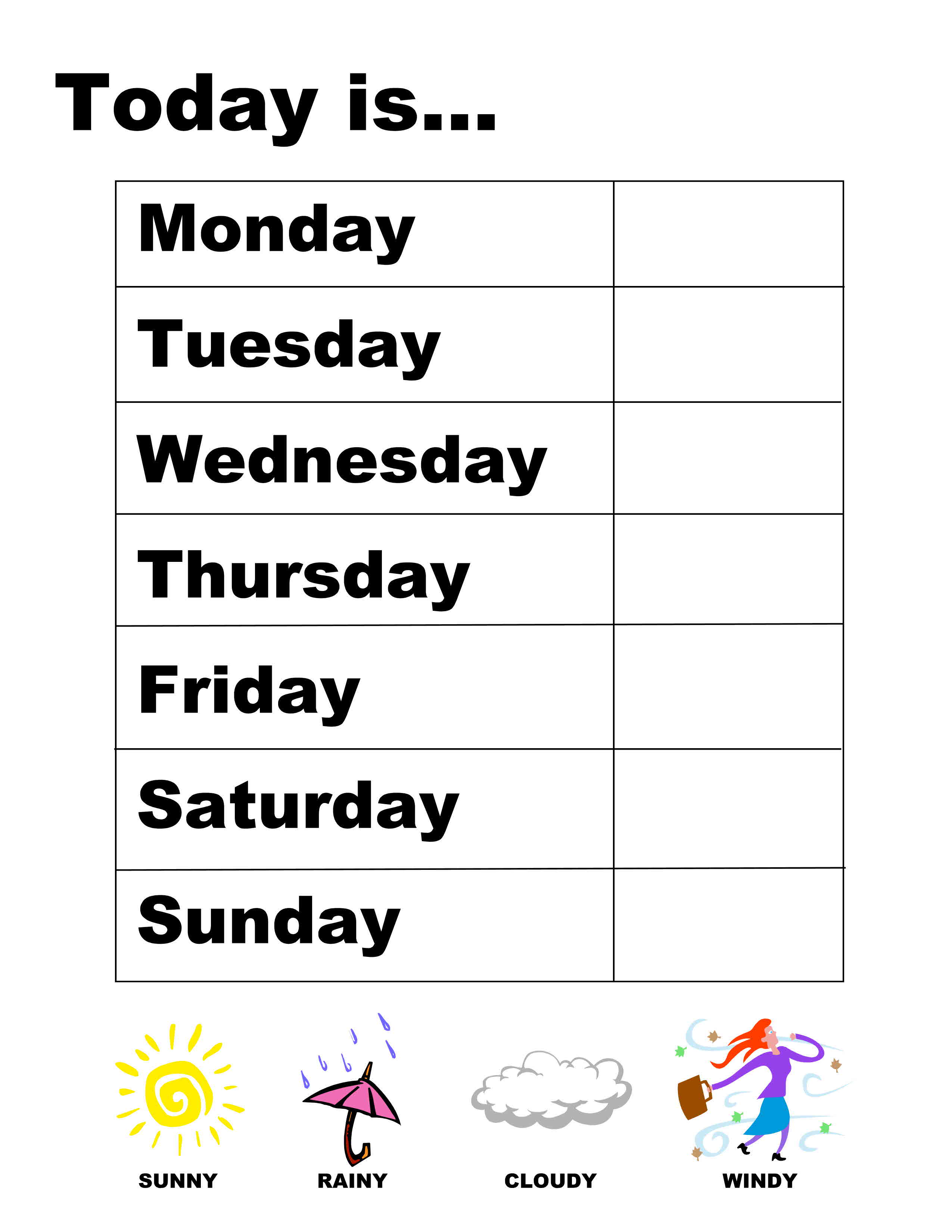
Toddler Activity - Learn About Days and Weather

Here's a daily bonding activity between you and your toddler. It will only take a few minutes at most and will help him or her learn about the days of the week and the weather.

[1] You will need two magnets.

[2] Print out the image and stick to your fridge.

[3] Every morning, guide your toddler in placing a magnet in the appropriate day slot.

[4] Then, have your toddler look out the window and observe the weather. Guide him or her in placing a magnet on top of the appropriate weather symbol.

[5] Repeat everyday until your toddler familiarizes himself/herself with the days of the week and the weather. You can also have him/her spell out the letters of each day to practice identifying uppercase and lowercase letters.

CAUTION: Do not use small magnets that can be swallowed. Always keep an eye on toddlers when handling magnetic objects.

Today is...

Tuesday, June 21, 2011

There's ABC and then there's abc

If you're starting to teach your toddler lowercase letters, you might want to consider using Kumon's ABC's Write and Wipe Lowercase Letters. This pack of flash cards represents each of the letters of the alphabet in lowercase format. Each card has the letter on one side and a sample word and picture on the other side. What differentiates it from other flash cards is that the letter side follows a tracing format using broken / dashes lines, which toddlers can attempt to follow using a pen (included in the pack). Once done, you can use the eraser (attached to the pen) to erase and have your toddler try again! The letters are quite big, perfect for first time writing attempts and the reusability factor is a must when dealing with kids this young. My only gripe is that the pictures are not colored, so it's difficult to identify some of them. Also while most cards feature a word that starts with the given letter, X is the exception - it shows the word "OX", which confused my child at first given the consistent pattern of the other cards. They could have used xylophone, at least.

Still, I'm satisfied with using the cards to practice lowercase letter recognition, writing, and spelling/reading. This pack of cards and other Kumon products are available locally, at Fully Booked.

Saturday, April 30, 2011

Schooling Starts At Home: Writing for Toddlers

Continuing my first post in this series...

I'm starting to teach my daughter how to write. Since she's just 2 years old, I'm concentrating more on her hand control than on actual writing of letters and numbers. Here are the things I've tried so far, and progress has been good:

(1) Magna Doodle - drawing board and stylus toy that allows children to scribble and erase as much as they want. These come in a variety of colors, shapes, and sizes and are easily available these days. Nearly all toy stores carry it! I chose a brand with a stylus that had a rounded tip so as to lessen the risk of poking one's eyes.

(2) Coloring Books and Baby's First Crayons - since I don't expect my daughter to color between the lines yet, I just let her loose on coloring books of her favorite characters using big crayons suited for little fingers (be sure to check for the NON-TOXIC label!). There are a lot of jumbo coloring books available at affordable prices. I prefer the Copy The Color books so she can at least practice color identification while scribbling wildly with her crayons.

(3) Dry Erase Writing Books - write, erase, write again! Choose versions that have basic writing exercises in the first few pages - these are pages full of straight and curved lines going up and down and left and right. I guided my daughter through these exercises (i.e., held her hand and helped her write) everyday until she was able to trace on her own. It's slow-going, but she's getting there. Once she gets the hang of it, we'll proceed to (5).

(4) Hand exercises - I have her crumple paper (I use old magazines for this), play with clay and puzzles, put beads on a stick, etc. regularly

(5) Once she manages to trace lines on her own, we'll move on to mazes and connect-the-dots, and then to the letters and numbers :)

Friday, April 22, 2011

Schooling Starts At Home - Teaching Babies and Toddlers

At 2.5 years old, my toddler is able to speak full sentences; can recognize and identify letters, numbers, shapes, colors, and body parts; has memorized at least 10 nursery rhymes and 3 Dora books; knows her fruits, vegetables, and animals; and can count to 50. She is currently learning how to read and write. She accomplished all these long before I enrolled her in Gymboree classes. I'm often asked by parents and yayas if she goes to school already, to which I say no - I've been teaching her myself since she was born. I haven't followed any tried-and-tested approach or teaching methods, mostly I just played it be ear, so I thought it best to list some of the things I tried that seemed to work:

(1) Start reading and singing nursery rhymes to them early on. Even if it seems like it's a useless effort as they don't appear to listen or understand, it does get through. This is evident in the way my daughter - when she finally learned to talk - suddenly sang the songs we sung to her when she was less than a year old. I had a yaya who sang Nobody (Wonder Girls) when she was about a year old. She'd changed yayas since and no one else sang that to her. Imagine her current yaya's shock when she suddenly burst out "nobody, nobody but you!" just the other week, complete with head bobbing action.

(2) Introduce them to books. I can't stress this enough. Let them handle books appropriate for their age to get them interested. I started with Fisher Price books with bright colors. Dora's Little Library came next - it's just perfect for little hands! I also kept telling her that books were not toys. She was not allowed to tear, bend, or fold the pages, or stand/sit on the books. Fully Booked is her favorite jaunt now and she has a huge collection of Barney, Dora, Pooh Bear, and Mickey Mouse books.

(3) Allow them to watch educational shows while eating. When we first introduced solid food, we also introduced her to TV for the first time. She could watch TV while eating, and we showed her Sesame Street videos full of songs that teach ABCs, numbers, colors, shapes, and body parts. This made her grasp basic concepts easily and she actually enjoys eating (I have a lot of friends whose babies refuse to eat so this is a coup for me!). The only drawback was that she eventually graduated to Barney and would watch over and over and over again. She eventually got off this habit though.

(4) Make every moment a learning experience. Buy alphabet bath stickers for the bath. Show her colors and shapes when you're out and about or while playing with her toys. Make her count groceries while sitting in the shopping cart.

(5) NO baby talk. Treat them like little adults so they will learn to act and speak accordingly. You'll be surprised at how they will try to pick up singular-plural and past-present-future tense rules on their own by listening to you speak. Refrain from screaming and shouting when they do something wrong or won't stop crying. Instead, explain things to them calmly, in simple terms they will understand. Keep talking and they'll eventually calm down. And yes, the lecture does get through to them.

(6) Teach them regularly. When my daughter turned 1, I started teaching her ABCs, numbers, colors, shapes, and animals through Brainy Baby books. Flash cards were also a big help. It's best to use simple flash cards, I got ones with the letter in front and sample word and picture at the back. I found that cards with too much information on one side - especially those featuring popular characters such as Mickey Mouse or Barney - were too distracting. This was also about the time we started her on the First 1000 words book.

(7) Do as you teach. My daughter saw me and my husband reading (even if only comics and magazines) and wanted to read as well. She saw her lola do crossword puzzles and wanted to learn how to write. She saw us building puzzles and wanted to try it out on her own. Toddlers love to emulate - be sure to be a good role model to them. If you want them to say Please and Thank You, be sure to always say these key phrases when you hold conversations with other people.

Time to put my toddler to bed :) More tips to come on my next post!