If your tot can already recognize numbers (at least 1 to 10), now is a good time to introduce him/her to the concept of time. Start with the simple hours - 1 o'clock, 2 o'clock, etc. Don't worry about minutes yet. The important thing is that they can differentiate between the short and long hand and know that they base the hour on the short hand.
Give them a toy clock to practice telling time. It can be as simple as a cardboard clock with movable hands. My favorite find is Joytoy's version, which is readily available at toy stores and National Bookstore. One side of the inexpensive cardboard clock has movable hands while the other side features a clock with no hands - instead, your tot can draw the hands using a dry-erase marker. You can start teaching your child via the movable hands and use the flip side when he/she is a little bit older.
Once your child has a basic idea of how to tell time, you can reinforce the concept by referring to the real clock for times of the day that are important to him/her. For example, just before his/her favorite show comes on, you can say "Look, what time is it? The clock says it's 7 o'clock! That means it's time for Mickey Mouse!". You can also refer to the specific hour of the day that he/she will take a nap, sleep, take a bath, eat, etc. Pretty soon your tot will realize the importance of looking towards the clock in order to tell the time.
Showing posts with label Teach Babies and Toddlers. Show all posts
Showing posts with label Teach Babies and Toddlers. Show all posts
Thursday, August 18, 2011

Thursday, June 30, 2011
Toddler Activity - Learn About Days and Weather
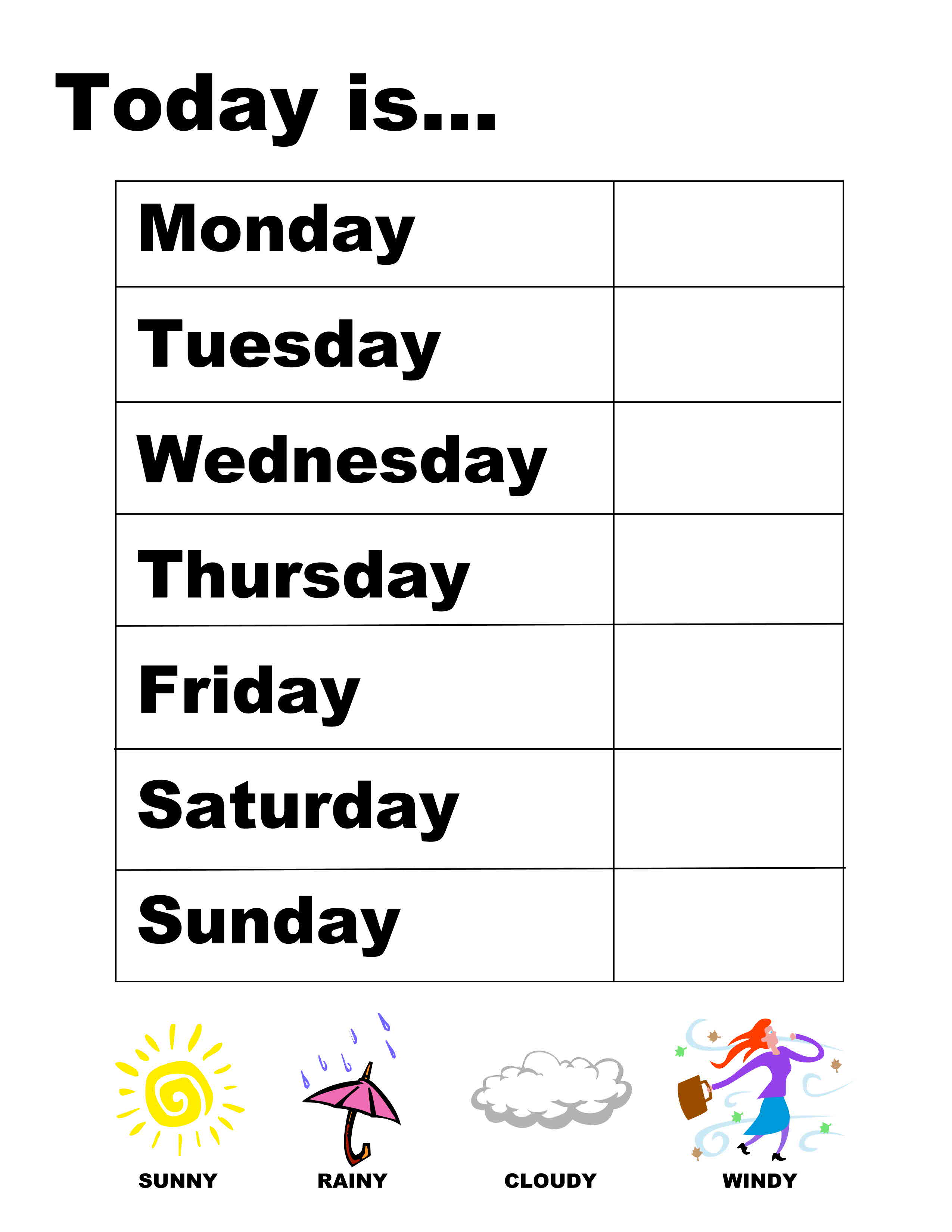
Here's a daily bonding activity between you and your toddler. It will only take a few minutes at most and will help him or her learn about the days of the week and the weather.
[1] You will need two magnets.
[2] Print out the image and stick to your fridge.
[3] Every morning, guide your toddler in placing a magnet in the appropriate day slot.
[4] Then, have your toddler look out the window and observe the weather. Guide him or her in placing a magnet on top of the appropriate weather symbol.
[5] Repeat everyday until your toddler familiarizes himself/herself with the days of the week and the weather. You can also have him/her spell out the letters of each day to practice identifying uppercase and lowercase letters.
CAUTION: Do not use small magnets that can be swallowed. Always keep an eye on toddlers when handling magnetic objects.
Tuesday, June 21, 2011
There's ABC and then there's abc
If you're starting to teach your toddler lowercase letters, you might want to consider using Kumon's ABC's Write and Wipe Lowercase Letters. This pack of flash cards represents each of the letters of the alphabet in lowercase format. Each card has the letter on one side and a sample word and picture on the other side. What differentiates it from other flash cards is that the letter side follows a tracing format using broken / dashes lines, which toddlers can attempt to follow using a pen (included in the pack). Once done, you can use the eraser (attached to the pen) to erase and have your toddler try again! The letters are quite big, perfect for first time writing attempts and the reusability factor is a must when dealing with kids this young. My only gripe is that the pictures are not colored, so it's difficult to identify some of them. Also while most cards feature a word that starts with the given letter, X is the exception - it shows the word "OX", which confused my child at first given the consistent pattern of the other cards. They could have used xylophone, at least.
Still, I'm satisfied with using the cards to practice lowercase letter recognition, writing, and spelling/reading. This pack of cards and other Kumon products are available locally, at Fully Booked.
Still, I'm satisfied with using the cards to practice lowercase letter recognition, writing, and spelling/reading. This pack of cards and other Kumon products are available locally, at Fully Booked.
Saturday, April 30, 2011
Schooling Starts At Home: Writing for Toddlers
Continuing my first post in this series...
I'm starting to teach my daughter how to write. Since she's just 2 years old, I'm concentrating more on her hand control than on actual writing of letters and numbers. Here are the things I've tried so far, and progress has been good:
(1) Magna Doodle - drawing board and stylus toy that allows children to scribble and erase as much as they want. These come in a variety of colors, shapes, and sizes and are easily available these days. Nearly all toy stores carry it! I chose a brand with a stylus that had a rounded tip so as to lessen the risk of poking one's eyes.
(2) Coloring Books and Baby's First Crayons - since I don't expect my daughter to color between the lines yet, I just let her loose on coloring books of her favorite characters using big crayons suited for little fingers (be sure to check for the NON-TOXIC label!). There are a lot of jumbo coloring books available at affordable prices. I prefer the Copy The Color books so she can at least practice color identification while scribbling wildly with her crayons.
(3) Dry Erase Writing Books - write, erase, write again! Choose versions that have basic writing exercises in the first few pages - these are pages full of straight and curved lines going up and down and left and right. I guided my daughter through these exercises (i.e., held her hand and helped her write) everyday until she was able to trace on her own. It's slow-going, but she's getting there. Once she gets the hang of it, we'll proceed to (5).
(4) Hand exercises - I have her crumple paper (I use old magazines for this), play with clay and puzzles, put beads on a stick, etc. regularly
(5) Once she manages to trace lines on her own, we'll move on to mazes and connect-the-dots, and then to the letters and numbers :)
Friday, April 22, 2011
Schooling Starts At Home - Teaching Babies and Toddlers
At 2.5 years old, my toddler is able to speak full sentences; can recognize and identify letters, numbers, shapes, colors, and body parts; has memorized at least 10 nursery rhymes and 3 Dora books; knows her fruits, vegetables, and animals; and can count to 50. She is currently learning how to read and write. She accomplished all these long before I enrolled her in Gymboree classes. I'm often asked by parents and yayas if she goes to school already, to which I say no - I've been teaching her myself since she was born. I haven't followed any tried-and-tested approach or teaching methods, mostly I just played it be ear, so I thought it best to list some of the things I tried that seemed to work:
(1) Start reading and singing nursery rhymes to them early on. Even if it seems like it's a useless effort as they don't appear to listen or understand, it does get through. This is evident in the way my daughter - when she finally learned to talk - suddenly sang the songs we sung to her when she was less than a year old. I had a yaya who sang Nobody (Wonder Girls) when she was about a year old. She'd changed yayas since and no one else sang that to her. Imagine her current yaya's shock when she suddenly burst out "nobody, nobody but you!" just the other week, complete with head bobbing action.
(2) Introduce them to books. I can't stress this enough. Let them handle books appropriate for their age to get them interested. I started with Fisher Price books with bright colors. Dora's Little Library came next - it's just perfect for little hands! I also kept telling her that books were not toys. She was not allowed to tear, bend, or fold the pages, or stand/sit on the books. Fully Booked is her favorite jaunt now and she has a huge collection of Barney, Dora, Pooh Bear, and Mickey Mouse books.
(3) Allow them to watch educational shows while eating. When we first introduced solid food, we also introduced her to TV for the first time. She could watch TV while eating, and we showed her Sesame Street videos full of songs that teach ABCs, numbers, colors, shapes, and body parts. This made her grasp basic concepts easily and she actually enjoys eating (I have a lot of friends whose babies refuse to eat so this is a coup for me!). The only drawback was that she eventually graduated to Barney and would watch over and over and over again. She eventually got off this habit though.
(4) Make every moment a learning experience. Buy alphabet bath stickers for the bath. Show her colors and shapes when you're out and about or while playing with her toys. Make her count groceries while sitting in the shopping cart.
(5) NO baby talk. Treat them like little adults so they will learn to act and speak accordingly. You'll be surprised at how they will try to pick up singular-plural and past-present-future tense rules on their own by listening to you speak. Refrain from screaming and shouting when they do something wrong or won't stop crying. Instead, explain things to them calmly, in simple terms they will understand. Keep talking and they'll eventually calm down. And yes, the lecture does get through to them.
(6) Teach them regularly. When my daughter turned 1, I started teaching her ABCs, numbers, colors, shapes, and animals through Brainy Baby books. Flash cards were also a big help. It's best to use simple flash cards, I got ones with the letter in front and sample word and picture at the back. I found that cards with too much information on one side - especially those featuring popular characters such as Mickey Mouse or Barney - were too distracting. This was also about the time we started her on the First 1000 words book.
(7) Do as you teach. My daughter saw me and my husband reading (even if only comics and magazines) and wanted to read as well. She saw her lola do crossword puzzles and wanted to learn how to write. She saw us building puzzles and wanted to try it out on her own. Toddlers love to emulate - be sure to be a good role model to them. If you want them to say Please and Thank You, be sure to always say these key phrases when you hold conversations with other people.
Time to put my toddler to bed :) More tips to come on my next post!
Subscribe to:
Posts (Atom)